



You are here: Home > Your Loss > Family Loss > Death of a Parent > > Dealing With the Death of an Abusive Mother

Dealing With the Death of an Abusive Mother

Question: Two weeks ago, my mother died of metastatic cancer. We had a strained relationship our entire life together. Growing up she could be very cruel to me, and that is what ensued as I tried to care for her. Before her illness, we hadn’t spoken in almost 3 years, but I wanted to be there for her and support her. I forgave her before she died and asked that she forgive me, and I feel a certain amount of closure which we were able to create.

But just when things were going beautifully, it was as if some demonic entity took over her being. Right after we had a beautiful, forgiving, loving moment, her pulse stopped and then it started again. When she came back she was a different person: angry, yelling, saying horrible things to me and about me. I know it was probably the cancer talking, but now I just feel so alone and am fighting the feelings that I am trash and unworthy, even though I know that is not true.

Response: I’m so sorry to learn of the troubles you’re having in the aftermath of your mother’s difficult death, which is complicated by the continuing tension that existed between the two of you for many, many years.

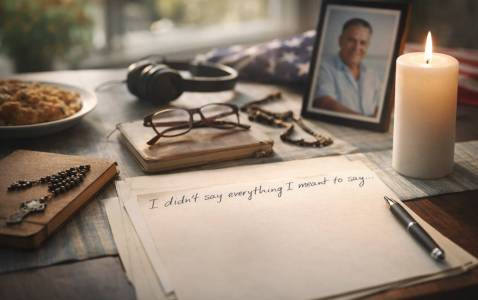
When there are significant problems in a relationship and one of the parties dies, a lot of business is left unfinished, including arguments unresolved, words unspoken, questions unanswered, and love undeclared. The survivor is left hanging in mid-air, unable to complete her relationship with the deceased, unable to mourn, and stuck in the pain of her grief.

In The Mourning Handbook, author and grief expert Helen Fitzgerald offers various ways to finish what we call “unfinished business” (such as not having a chance to say goodbye or “I love you” one more time; feeling a strong need to apologize for something you said or did or failed to say or do; or needing to confront your mother on her behavior toward you before her death).

She suggests listing and writing down everything that was left unfinished, thinking about each thing on the list, then considering what you could do to get some relief and put some closure on it. For example, you could write a letter, make an audio tape, write a song or poem, paint a picture, make a collage – whatever works for you – addressing your unfinished business and stating how you would have wanted it finished.

If you find this too difficult to do on your own, you might consider seeking the understanding and support of a grief counselor or therapist.  Turning to trusted friends and family members for support is fine, but sometimes such folks may worry too much about you, or get too involved in your personal affairs, or not be available to you at all.  When it seems that support from friends and family is either too much or not enough, a few sessions with a bereavement counselor may give you the reassurance, understanding and comfort that you need.

When your grief at losing your mother is complicated by the abuse that you’ve experienced, you may find it difficult to share it with other family members or friends. (For example, you may have found it hard to sit through your mother’s funeral or memorial service because of what you know about your relationship or how you are feeling. As Helen Fitzgerald says, “it’s hard to play the role of the mourning [daughter] when part of you is saying, ‘Free at last.’”)

How can you find grief support in your own community? Look up your local mental health association or your local suicide prevention center. Either agency will have good grief referral lists. You need not be suicidal to get a grief referral from a suicide prevention center.

Use the phone book and call hospitals and hospices near you. Ask to speak with the Bereavement Coordinator, Social Worker, or Chaplain’s Office to get a local grief referral. Many hospitals and hospices provide individual and family grief support to clients for up to one year following a death, and offer bereavement support groups to the general public at no cost.  The National Hospice and Palliative Care Organization maintains a database of hospices for each state in the United States.  To search for a hospice in your own community, click on Finding a Local Hospice.

I also want to recommend to you a book about this sort of loss, entitled Liberating Losses: When Death Brings Relief, by Jennifer Elison and Chris McGonigle. In the words of noted grief expert Ken Doka, “This book is a gift to those struggling with unfinished business and ambivalent feelings.”

Marty Tousley, CNS-BC, FT, DCC can be reached through her websites, http://www.griefhealing.com and http://www.hovforum.ipbhost.com, and her blog, http://griefhealingblog.blogspot.com/

This entry was posted in Death of a Parent and tagged , , by Marty Tousley. Bookmark the permalink.
Marty Tousley

About Marty Tousley

As both a bereaved parent and a bereaved child herself, Marty Tousley, CNS-BC, FT, DCC has focused her practice on issues of grief, loss and transition for more than 40 years. She joined Hospice of the Valley in Phoenix, AZ as a Bereavement Counselor in 1996, and now serves as moderator for its online Grief Healing Discussion Groups. A frequent contributor to health care journals, newsletters, books and magazines, she is the author of Finding Your Way through Grief: A Guide for the First Year: Second Edition, The Final Farewell: Preparing for and Mourning the Loss of Your Pet, and Children and Pet Loss: A Guide for Helping. She has written a number of booklets for Hospice of the Valley including Explaining the Funeral /Memorial Service to Your Children and Helping Another in Grief, as well as monthly columns, e-books and online e-mail courses for Self-Healing Expressions, addressing various aspects of grief and loss. With her special interest in grief and the human-animal bond, Marty facilitated a pet loss support group for bereaved animal lovers in Phoenix for 15 years, and now serves as consultant to the Pet Loss Support Group at Hospice of the Valley and to the Halton-Peel Pet Loss Support Group in Ontario, Canada. Her work in pet loss and bereavement has been featured in the pages of Phoenix Magazine, The Arizona Republic, The East Valley Tribune, Arizona Veterinary News, Hospice Horizons, The Forum (ADEC Newsletter), The AAB Newsletter, Dog Fancy Magazine, Cat Fancy Magazine, Woof Magazine and Pet Life Magazine. On the Web since January, 2000, Marty’s Grief Healing site offers information, comfort and support to anyone who is anticipating or mourning the loss of a loved one, whether a person or a cherished companion animal. She is certified as a Fellow in Thanatology (Death, Dying and Bereavement) by the Association for Death Education and Counseling, as a Distance Credentialed Counselor by the Center for Credentialing and Education, and as a Clinical Specialist in Adult Psychiatric/Mental Health Nursing Practice by the American Nurses Association. Marty and her husband Michael have two grown sons and four grandchildren. They spend their winters in Scottsdale, AZ and Sarasota, FL, and enjoy their summers in Traverse City, MI. Marty welcomes reader questions and comments, and can be contacted at tousleym@aol.com or through her Web site, at www.griefhealing.com.

2 thoughts on “Dealing With the Death of an Abusive Mother

  1. An Abusive Mother’s hatred for her daughter is overwheming. This is killing the loving and caring Father. Her abusive nature has separated the Father from his Family. What scares me the most is….. that Her abusive nature is showing up in my young son’s personality.

  2. Eloise, dear, your comment touches my heart, and I’m so sorry ~ but if this were my own son, and if I had similar concerns as you describe, I would want him evaluated by a professional who specializes in and thoroughly understands normal childhood growth and development and child psychology. Doing so would help you better understand what’s going on with him, get at the root of his behavior and offer you suggestions for how to deal with it. I encourage you to consult with your family physician or your son’s teacher. They should be able to guide you with a referral to someone in your community who is qualified to evaluate your son, his personality and his behavior. Please know that I am thinking of you and wishing you all the best.

Leave a Reply

Your email address will not be published. Required fields are marked *

*

You may use these HTML tags and attributes: <a href="" title=""> <abbr title=""> <acronym title=""> <b> <blockquote cite=""> <cite> <code> <del datetime=""> <em> <i> <q cite=""> <strike> <strong>